Reader Sohan D'Souza shares his food love experiences in China. A sumptuous and visually stunning journey through an exotic land of culinary excellence. I hope you enjoy it.
Eating is more important than the Emperor
- Chinese Proverb
Chinese food. It means many things to many people, from sumptuous exotic banquets to cheap takeaway in a cardboard container.
Like Indian food, it has changed over time, thanks to innovation and globalization (especially the Columbian Exchange, with potatoes and chili no longer considered foreign ingredients). It has been adapted in so many places to cater to a variety of tastes, so that it becomes barely recognizable to a purist. Crab "Rangoon" (Rangoon is in Burma, and cheese does not exist in Chinese kitchens) and Vegetable "Manchurian" (surely the Qing dynasty emperors must be spinning in their graves) come to mind here, tasty as they are.
As a Chinese history geek, I took this trip across the length and breadth of the country primarily to satiate my long-held desire to visit sites and view artifacts that I had previously only seen in books, websites, films and TV series. But culture is an important facet of history, and food is an important facet of culture. My journey turned to be as gastronomical as it was historical, as I sampled my way from Beijing in the north to Yangshuo in the south, and from Shanghai in the east to Xiían in the west, eating on the street and in restaurants, trying everything from the ancient and traditional to the modern and cosmopolitan.
Records of the Grand Diner
As with many other cultures, food is a central pillar of Chinese culture. Each festival has an associated treat - Zongzi for the Dragon Boat festival, Yuebing at Mid-Autumn, Tangyuan for the Lantern Festival, and Niangao at the Chinese New Year.
Each region has a distinctive flavor influenced by climate and biodiversity, although the migration within the country has resulted in a lot of culinary creep and cross-pollination. Local availability of fish, vegetables and herbs is no longer as restrictive as it used to be, but the historical culinary traditions based on it persist.
As a staple, wheat is more common than rice in the north, while the opposite is true for the south. Spring onions, garlic and ginger form the "holy trinity" flavor base, with soy sauce providing savory wetness.
Chili is not confined to Sichuan cooking, especially in northern cuisines, which have adopted it for everything from noodles to skewers. The southern cuisines tend to be more sweet and saucy, especially with the use of oyster sauce. Chinese food of the authentic sort is not nearly as widely bland as it is sometimes made out to be. Tastes range from subtle to eye-watering explosive. As with most cuisines, the tastier dishes are often prepared with quite a lot of oil, and fat is often just left on meat.
Speaking of meat ...
 |
| Statues of livestock buried in Han dynasty tombs near Xi'an. Clockwise from top left: cattle and horses, pigs, chickens, goats |
Emperors and kings made sure enough food supplies were buried with them for the afterlife. Apart from famous vast formations of soldiers and attendants immortalized in clay, they would also have clay statues of livestock in their tombs to feed their souls post-mortem.
In Chinese cuisine, while chickens, goats, cattle and even the occasional horse or dog (depending on the region) found their way onto the dining table, it is the pig that provides the meat mainstay of the cuisine. The very word for "meat" means pork, if not qualified with the name of another animal.
 |
|
Some ancient Chinese kitchen implements in museums. Clockwise from top
left: clay jars and roller set, bronze cleaver and knife, stone mortar
and pestle, bone spoon |
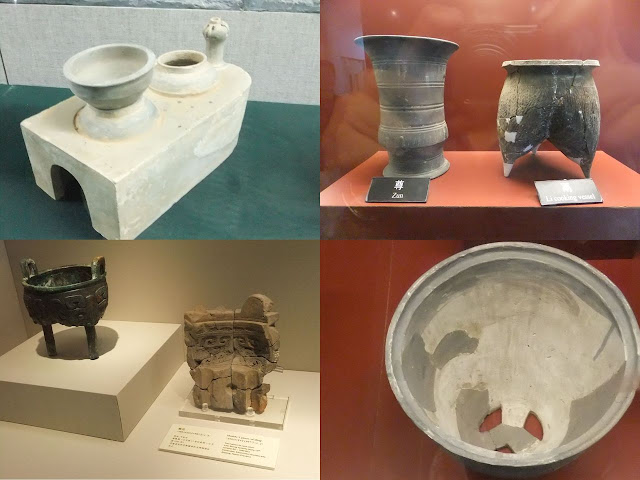 |
| Some ancient Chinese kitchen utensils in museums. Clockwise from top
left: pottery stove, pottery wine vessel and tripod pot, pottery
steamer, bronze tripod and casting mold fragment |
The ancient Chinese kitchen is in many ways similar to the one we are familiar with today. Cleavers, rollers, steamers and spatulas were used in food preparation, as in olden times. Steaming baskets were nowhere to be seen in the museums, but I guess this is because they tended to decay. While clay and metal pots were used for stewing in olden days, the tripod was a more common utensil configuration than it is now, possibly because it was easy to put a flame directly under it without any need for a stove. I am not aware of any other civilization that used tripods to this extent. The casting of bronze vessels of intricate detail was an art that reached its contemporary zenith in ancient China. Such vessels, especially of the tripod and quadripod variety, were status symbols and even denoted rank in nobility.
Culinary Raids of the Southern Barbarian
Being a Chinese history geek, it was my dream to go to China for years. While it was probably not the best time to visit in terms of weather, I had a tiny window of opportunity in peak summer that I had to take. Fortunately, I was spared rain on almost all my days in the country, although the heat and humidity made the southern coastal cities a bit uncomfortable.
Beijing, Xi'an, Luoyang, Zhengzhou, Anyang, Kaifeng, Nanjing and Hangzhou had to be on the itinerary, as historical imperial capitals. I threw in Suzhou as it was on the way, and as it was a former hegemonic royal capital and renowned as a garden city. Then Shanghai - an obligatory urban stop - followed by Guilin and Yangshuo to wind down and enjoy some scenery and nature. That's 12 cities. And I had 19 days to make the best of them.
As enthusiastic as I am about the subject, I will spare readers the history lectures and get down to this hopefully representative sample of the large food photography collection accumulated on the trip.
 |
| Century eggs in Beijing, served in traditional style. |
I wonder how these even got invented. The chicken eggs preserved in this rather odd mixture of clay, lime, tea, ash and salt get gradually treated over time (much less than a century, in case you were wondering) so the yolk becomes mushy and greenish, and the white becomes tougher, gelatinous and cola-colored. An acquired taste (and appearance), to be sure. Fortunately, I had already acquired it years ago, and could not pass up the opportunity.
 |
Jiaozi in Beijing.
|
Like the momos of Tibetan cuisine, with a wide variety of styles and stuffing. Succulent and savory.
 |
| Baozi in Luoyang |
The best steamed stuffed buns I ever ate, from a cafeteria near the train station. So good I was popping them like golgappas.
 |
| Cold spicy noodles from a Xi'an street vendor. |
One of the tastiest street foods I ate in China. The noodles had just the texture to slightly absorb the tangy sauce poured over them.
 |
| Noodles with vegetables in Anyang. |
Perhaps one of the best noodle dishes I ate in China, but not the hottest (the late-night Pepper Chao Mian in Xi'an gets that honor, for blowing open sinuses I didn't know I had). Subtly flavored, topped with juicy shredded fresh vegetables, served on a steaming platter. I wolfed it down with much gusto.
 |
| Fried tofu slabs in an Anyang market street. |
This is a popular street food in China, filling and flavorful.
 |
|
Iron pot noodles with vegetables and mushrooms in Zhengzhou. |
Doesn't look it, but it's extremely spicy. And, as these last four photos show, Chinese food is not a grand carnivorous feeding frenzy. A significant portion of what I ate in the country was 100% vegetarian.
 |
|
Pork with vegetables in Kaifeng. And probably inadvisable amounts of chilli. |
 |
| Stewed beef with long mushrooms in Nanjing. Extremely tender and delicious. |
 |
| Dongpo's Pork in Hangzhou |
A Hangzhou "celebrity dish," it was supposedly invented by the famous Song-dynasty prefect of the city, Su Dongpo, who also happened to be a poet. Squares of pork belly are briskly fried and then red-braised until meat becomes very tender and juicy. So tender it has to be tied on four sides, lest it fall apart before getting to the dinner table. And so good I had to have it for lunch AND dinner.
 |
|
River fish with vegetable stew, and the Three Earth Delicacies in Suzhou. |
Fish are a specialty of both coastal and riverside settlements in China. Some are quite bony, so be careful which ones you order. The Three Earth Delicacies is a popular dish in China, and refers to potato, eggplant and bell pepper stir-fried in a sweetish sauce.
 |
|
Rice noodles with horsemeat in Guilin. |
Rice noodles are popular in the south, served with peanuts, pickled chilli and chopped green beans. Use an egg to add body, if you like.
 |
| Braised duck in Yangshuo |
Darker, bonier and tougher than chicken, this fowl is most popular in the cuisine of China.
 |
| In
Yangshuo, a Chinese breakfast of rice porridge with chopped century egg
and lean pork mince, and fried dough sticks (which taste a lot like
poori). |
More selected food photos from this trip at http://sohandsouza.multiply.com/photos/album/21/Taste_of_China_2011
Tales from the Gastronomical Academy
Located on the banks of the Li River, Guilin and Yangshuo (and everywhere in between) are popular with tourists, both national and international, for the lush foliage running along rocky shores, over towering karst peaks and through scenic valleys.
A great way to get there is by a raft cruise, which will enable travelers to take in the glorious scenery (and sample a few riverside snacks along the way).
Yangshuo, with karst columns of green and grey all around, bustles with tourists, and the accompanying bazaars and international restaurants and bars. One of the popular tourist activities in Yangshuo is taking lessons in cooking up the local cuisine. After some pre-trip research, I set my sights on the Yangshuo Cooking School, which is right on the riverbank. A most scenic and atmospheric location for both the cooking and the subsequent noshing.
 |
| Before
the lessons began, we were taken to the main market to get a look at
some of the ingredients we would be using, and some we would not. |
 |
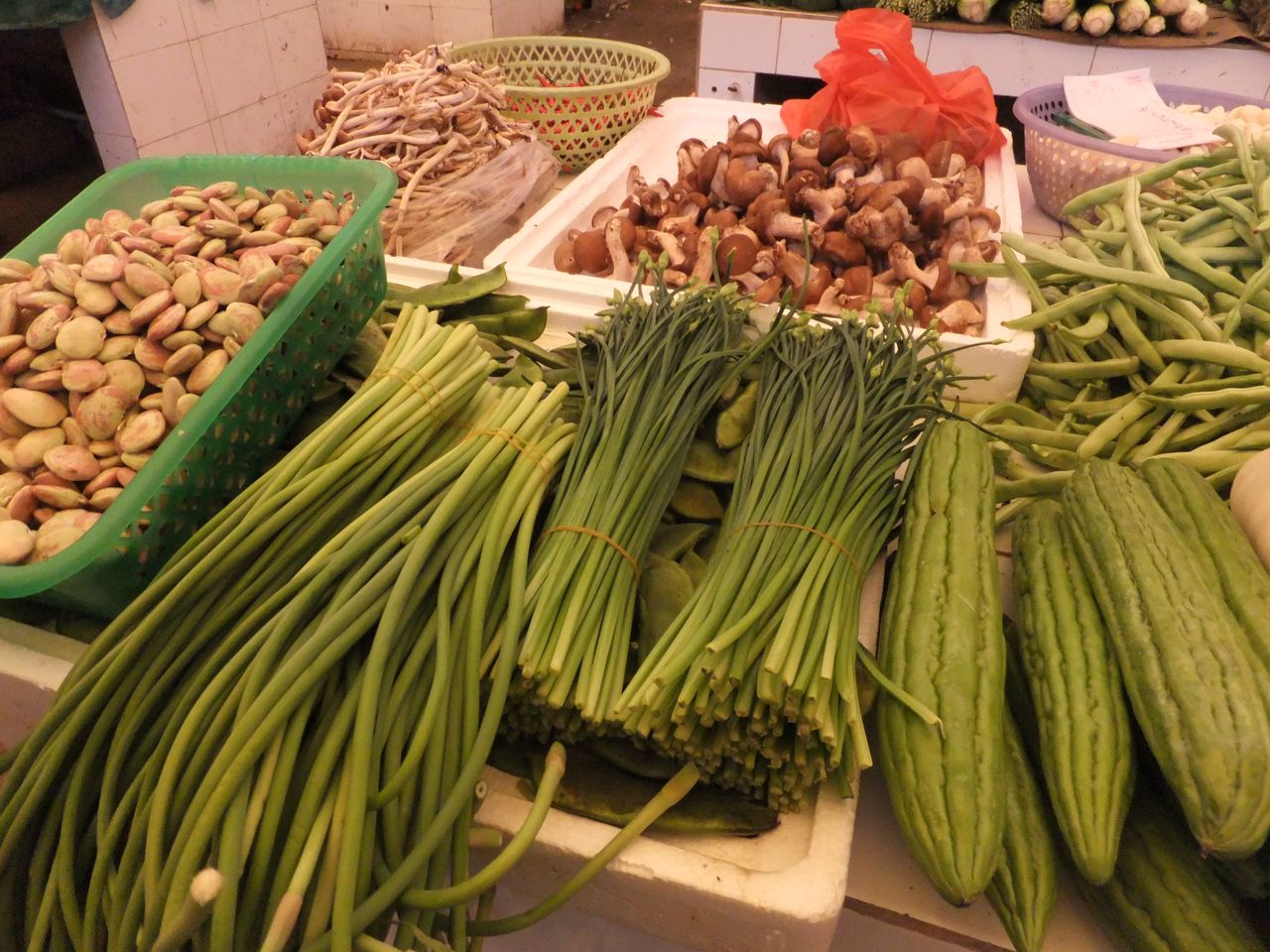
| Beans, garlic shoots, spring onions, sprouts, mushrooms and gourds |
 |
Lotus root, wood ear (a kind of fungus) and ginger (left)
Pumpkin flower and mint (right)
|
 |
|
Chinese red dates and assorted mushrooms and sauces (left). Tofu in all shapes and sizes (right). |
|
| |
|
|
|
|
|
 |
| The vegetables we were given (left).
Chopping away (right) |
 |
|
Voila! Pumpkin
flower, mushroom and tofu ball, stuffed with pork mince folded with
salt, oyster sauce and chopped spring onion. Ready for the steaming
basket, in preparation for Steamed Stuffed Vegetables.
|
Preparing
Yangshuo-style Eggplant.
1. Eggplant wok-fried in peanut oil till brown
and soft.
2. Garlic, ginger and Guilin's famous chilli paste added until
the aroma comes out. Then a little water and a dash of oyster sauce, on
high heat until it boils off.
3. Spring onions at the last minute.
Done!
Beer Fish up next
This too is a Yangshuo specialty.
1. Fish sprinkled with a little salt, pressed onto hot wok with skin side down until skin is brown and flesh is firm enough to avoid curling.
2. Crushed garlic and julienned ginger added, and fish is flipped. Red and green bell pepper and tomato added and stir-fried until soft, while fish is pushed to the side.
3. Push all to centre, then add dash of oyster and soy sauce with half a glass of beer.
4. Simmer until beer mostly boils off, leaving a thick sauce of remaining beer, ingredient juices and other sauces.
5. Spring onions at the last minute.
For Chicken with Cashew Nuts
1. First fry the raw cashew nuts in a wok until golden brown, then place aside.
2. Fry crushed garlic and ginger, black pepper and cubes of chicken breast until chicken becomes white, then mix soy sauce in.
3. Add cubes of carrot and broad-chopped ginger shoots with salt, and fry briefly.
4. A little water and oyster sauce, simmer until water evaporates, then serve with cashew nuts on top.
Garlic Bok Choy
Finally, bok choy is stir-fried with crushed garlic, a dash of salt, and a little water for steam, resulting in Green Vegetables with Garlic.
Steaming of the stuffed vegetables should be done by now.
 |
| And it's time to dig in! |
 |
| Sohan (@SohanDsouza) is an enthusiast of Chinese history, among many
other topics. When he is not working his day job as an informatics
researcher, he patronizes (and occasionally involves himself with) the
local drama, art and music scene, and performs unspeakable experiments
in his kitchen. He has recently been making forays into standup comedy
as well. While he too has fallen victim to the microblogging trend, he
does now and then muster the attention span to post an entry on his blog
at http://sohandsouza.multiply.com. |